
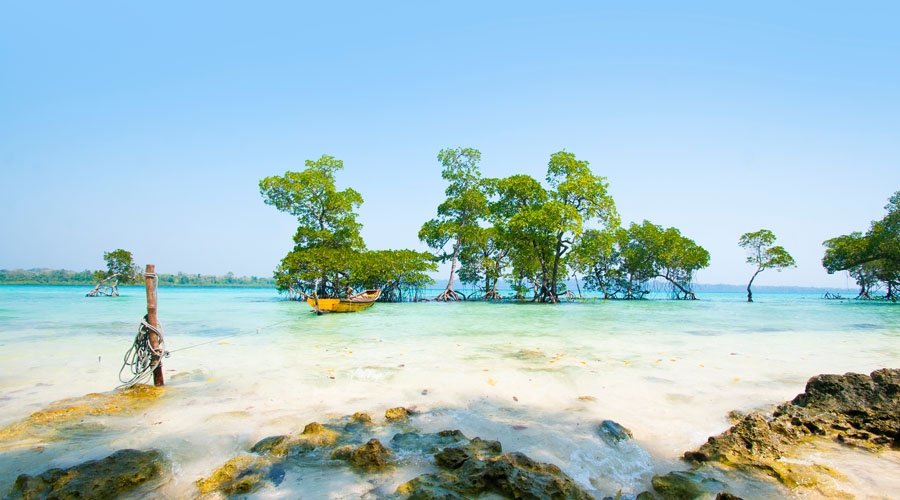
Amkunj Beach, set along the eastern coast of Middle Andaman near Rangat, offers more than a photogenic shoreline. Its story encapsulates how the Andaman Islands transitioned from remote settlements and resource-based livelihoods to a carefully nurtured, conservation-first tourism model. The beach’s evolution—rooted in ecology, access, community, and policy—illustrates how a small coastal stretch became a symbol of low-impact, nature-centered travel in the Andaman and Nicobar Islands.
Located a short drive from Rangat town, Amkunj Beach fronts the Andaman Sea with a distinctive mix of pebbles, coarse sand, and intertidal rock pools. Before tourism featured in local planning, the coastline served as a quiet zone for fishing communities and occasional picnics by residents. The area’s modest settlements and dense forest cover meant that the beach remained largely undisturbed, an outcome that preserved its coastal ecology and helped maintain nesting-friendly conditions for marine turtles along suitable stretches in and around Middle Andaman.
While the British colonial presence in the Andaman Islands centered on South Andaman (notably the penal settlement at Port Blair), Middle Andaman remained comparatively peripheral. After India’s independence, government-led settlement programs brought diverse communities from the mainland to islands such as Middle Andaman. Rangat emerged as one of the important population centers, with livelihoods revolving around agriculture, small-scale fishing, and forestry-linked occupations. Tourism, at this stage, was incidental rather than intentional.
The late 20th century saw progressive improvements in connectivity through the Andaman Trunk Road (ATR), linking South Andaman with Middle and North Andaman. With this came regular movement of goods, services, and people. As travelers began venturing beyond Port Blair to discover quieter corners, places like Rangat and its beaches—including Amkunj—gradually entered the visitor imagination. Early travelers were few, often naturalists, researchers, or backpackers seeking offbeat coastlines and mangrove habitats rather than conventional beach holidays.
As conservation ethics strengthened in the islands and across India, the emphasis shifted from resource extraction to protection of biodiversity. In Middle Andaman, this translated into small, thoughtfully designed visitor nodes that could offer recreation yet respect sensitive ecologies. Amkunj Beach became one such node. The Forest Department and local administration encouraged a model that minimized concrete, favored natural materials, and kept the footprint light—an approach in line with the broader ethos of eco-tourism that the Andamans are known for.
In the early 2000s, the Andaman and Nicobar Islands faced major environmental and infrastructural challenges, which, across the archipelago, strengthened awareness of coastal vulnerability. In the years that followed, planners and local communities at Rangat leaned further into resilient, low-impact tourism. Amkunj’s simple, nature-first facilities became a case study in keeping infrastructure modest, repairable, and respectful of natural processes.
As tourism gradually diversified beyond the famous southern beaches, Middle Andaman offered travelers a slower, more nature-immersive experience. Amkunj fit seamlessly into this circuit:
Over time, the community’s relationship with Amkunj moved from casual local recreation to a shared sense of stewardship. Vendors, guides, and families in Rangat internalized the value of a clean, tranquil, and respectful beach atmosphere. This supported:
The way Amkunj is used today reflects decades of learning: simple trails, shaded resting spots, and a strong ethic of leaving no trace. Travelers come for sunrise or late afternoon light, to sit on timbered benches, and to watch waves comb the pebbles. Many discover that the beach is not a classic swimming bay but a place for slow time—sketching, reading, photographing shorebirds, and listening to the sea.
Even with limited infrastructure, the beach faces typical island challenges: marine debris washing up after storms, seasonal erosion, and the pressure to add more facilities. Authorities and communities work to balance visitor comfort with conservation, often choosing less rather than more development to safeguard the coast’s character and ecological function.
Amkunj Beach embodies a shift in island tourism from spectacle to sensitivity. Its understated design, community stewardship, and conservation framing reflect how Middle Andaman believes tourism should look: respectful, educational, and restorative. In a landscape where infrastructure decisions directly influence fragile coasts and wildlife, Amkunj’s evolution shows that small, thoughtful choices can write a compelling history—one in which a beach remains true to itself even as it welcomes the world.
The story of Amkunj Beach is not about grand monuments or high visitor counts; it is about choosing restraint—a historical arc where the simplest interventions became the most meaningful for both people and place.
What makes us different from other tour package companies
Our travel experts have core and intense knowledge about Andaman sector with over 10 years of experience that will help you choose the best possible itinerary as per your requirements.
Our travel experts are just one call away during your tour to help you with any kind of immediate assistance so that your tour is a more enjoyable and hassle-free tour.
eAndamanTourism ensures best rates to all our esteemed guests since we have our own hotels and fleet of vehicles and drivers and there is no third-party involvement. This ensures personalized service and best rates.


Kindly enter the details below for your Andaman Tour Package


