
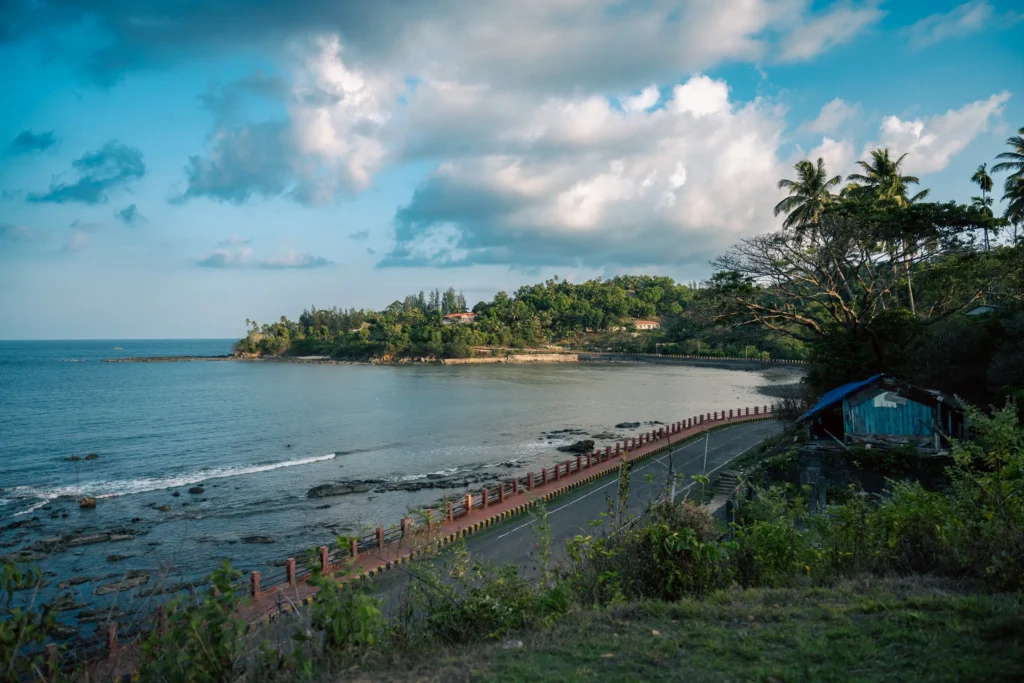
Corbyn’s Cove is Port Blair’s most accessible urban beach, a graceful crescent framed by coconut palms roughly 7 km from the city center. Overlooking the small offshore islet popularly known as Snake Island, it has long served as Port Blair’s natural promenade—a place where administrative history, wartime relics, and contemporary leisure intersect. For travelers, the cove offers a compact window into how the Andaman capital’s shoreline evolved from a colonial outpost frontage to a flagship urban beach central to the city’s tourism identity.
The name “Corbyn’s Cove” dates to the British period and is generally understood to reference a colonial-era official or surveyor named Corbyn whose work was associated with the Port Blair area in the 19th century. Historical maps and records from this era show the name (sometimes without the apostrophe as “Corbyns Cove”), underscoring the beach’s role in the maritime geography of South Andaman during the buildup of Port Blair as an administrative hub.
Prior to British settlement, South Andaman’s coasts, including the shoreline near present-day Corbyn’s Cove, were part of the ancestral seascapes of the Great Andamanese groups. Littoral foraging, canoeing, and seasonal movements tied people closely to coves and creeks. Colonial settlement and later urban growth reshaped access to these spaces, and tourism today sits atop layered histories of encounter, displacement, and adaptation. Visitors interpreting Corbyn’s Cove as a heritage space should do so with an awareness that modern leisure zones occupy coastlines with deep indigenous continuities and ruptures.
Port Blair’s early colonial story began in 1789 when the British established a settlement under Archibald Blair on nearby Chatham Island. This first phase was short-lived; the settlement was moved and later abandoned, but it introduced a pattern of surveying, mapping, and naming that placed features like Corbyn’s Cove onto official charts. These efforts set the geographical groundwork for later urban and recreational uses of the coastline.
Following the 1857 uprising on the mainland, the British re-established a penal settlement in the Andamans in 1858. Port Blair expanded, Ross Island (now Netaji Subhash Chandra Bose Island) became the administrative headquarters, and the town’s roads stitched together natural vantage points and breezy sea-fronts. As officers, families, and service staff sought reprieve from the routines of penal administration, nearby beaches such as Corbyn’s Cove emerged as convenient recreational outlets—a short carriage or, later, motor drive from the cantonment and bazaar areas.
By the late 19th and early 20th centuries, the cove’s gently shelving sands, coconut groves, and views to sea fitted the Imperial taste for seaside promenading. While not a “resort” in the formal sense, it seeded the idea of the urban beach as a part of Port Blair’s livability—an idea that post-independence tourism would amplify.
The coastline around Port Blair retains scattered colonial-era traces, but the most striking historical markers near Corbyn’s Cove are World War II bunkers and emplacements, a reminder that these shores were fortified and fought over in the 1940s.
During World War II, the Andamans were occupied by Japanese forces. They fortified strategic points around Port Blair, including areas close to contemporary leisure spaces like Corbyn’s Cove. The low, stout bunkers that visitors see today are tangible wartime artifacts. After the war, Allied administration returned, and the cove gradually resumed civilian use, yet the concrete remains continued to mark the coastline’s militarized past—elements now folded into the beach’s heritage appeal for tourists.
Post-1947, Port Blair shifted from a penal-administrative center to the capital of a Union Territory, with growing civilian population and public infrastructure. Steamer links and, later, scheduled flights improved access. As the city expanded, Corbyn’s Cove’s proximity made it the default “city beach,” suitable for evening outings and holiday strolls.
From the 1970s onward, the Andaman and Nicobar Administration and allied agencies began shaping a tourism portfolio for the capital region. Modest visitor amenities—parking, kiosks, seating, and beachside landscaping—emerged, framing Corbyn’s Cove as a family-friendly stop on city tours that also included the Cellular Jail, Aberdeen Bazaar, and boat trips to islands off Port Blair. In this period, the cove’s identity matured from incidental shoreline to planned urban attraction.
The tsunami of December 2004 impacted Port Blair’s waterfronts, including Corbyn’s Cove. Subsequent years saw repairs, beach nourishment in spots, improved drainage, and clearer coastal safety signage. The reconstruction efforts aligned with a broader rethinking of waterfront resilience and visitor risk communication across the islands.
From the late 2000s into the 2010s, Corbyn’s Cove embraced short-duration leisure services: jet-skis, parasailing (season- and weather-dependent), glass-bottom boat rides, and local snack stalls. Views toward Snake Island added a light snorkeling and boating narrative to the cove’s appeal, while sunset photography and quick beach picnics remained staples for short-stay visitors and conference delegates.
Authorities periodically post advisories based on sea conditions and occasional saltwater crocodile sightings reported in parts of South Andaman. Lifeguards, demarcated swim areas (when permitted), and restrictions during rough weather have become part of the modern tourism management toolkit. At the same time, beach vegetation maintenance, litter control, and limits on sand compaction for events reflect a gradual shift toward preserving the cove’s carrying capacity.
The cove’s name derives from the British era and is associated with an officer or surveyor named Corbyn who worked in the region during the 19th century. The exact personal identity remains a matter of historical attribution rather than a well-documented biography in public sources.
Yes. The concrete bunkers and emplacements around Port Blair’s coast date to the Japanese occupation (1942–1945). They are among the most accessible wartime relics for visitors to interpret.
No. In the colonial period it served more as a convenient recreational shoreline for residents and administrators. Organized tourism emerged post-independence, accelerated from the 1970s onward as infrastructure and visitor services grew.
Not always. Permissions depend on conditions and advisories. Authorities may restrict swimming due to rough seas or wildlife alerts. Check on-site notices and follow lifeguard guidance.
Corbyn’s Cove’s tourism story is not just about sun and surf; it is a layered coastal history that threads together indigenous seascapes, colonial urbanity, wartime fortification, and post-independence leisure planning. Understanding these layers enriches a visit, turning a quick beach stop into a more nuanced encounter with Port Blair’s past and present.
What makes us different from other tour package companies
Our travel experts have core and intense knowledge about Andaman sector with over 10 years of experience that will help you choose the best possible itinerary as per your requirements.
Our travel experts are just one call away during your tour to help you with any kind of immediate assistance so that your tour is a more enjoyable and hassle-free tour.
eAndamanTourism ensures best rates to all our esteemed guests since we have our own hotels and fleet of vehicles and drivers and there is no third-party involvement. This ensures personalized service and best rates.


Kindly enter the details below for your Andaman Tour Package


