
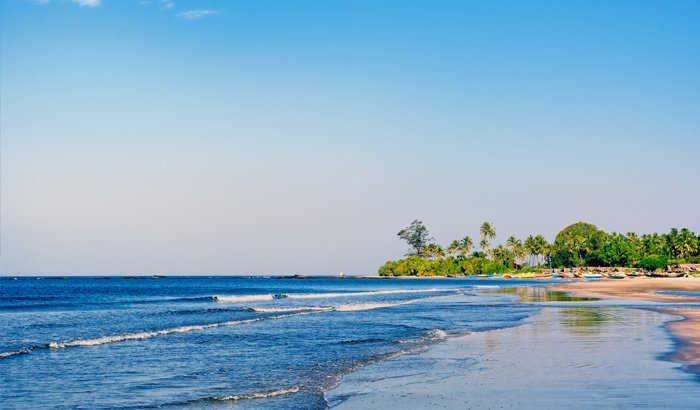
Laxmanpur Beach, on the western edge of Neil Island—officially Shaheed Dweep since 2018—is famed today for its long, white coral-sand shoreline and sweeping sunsets. The coast you see is the product of millennia of reef-building, wave action, and gradual accretion. The island sits in the Ritchie’s Archipelago of the Andaman group, fringed by living coral that forms a shallow reef-flat. At low tide, this flat becomes a natural classroom, revealing tidal pools, sea grass patches, and limestone formations.
The beach is commonly distinguished into two visitor zones: Laxmanpur Beach No. 1, the archetypal sunset strand, and Laxmanpur Beach No. 2, known for its intertidal walk and the photogenic natural limestone arch popularly nicknamed the “Howrah Bridge.” The latter epithet reflects the legacy of Bengali settler culture on the island.
The Andaman Islands have long been home to indigenous peoples, notably the Great Andamanese, Onge, Jarawa, and others. While permanent settlement on Neil Island is a modern phenomenon, the surrounding seas were part of the wider traditional maritime landscape. Precise, site-specific indigenous use of Laxmanpur is not well-documented, but the region’s historical tapestry includes seasonal foraging and seafaring practices that predate colonial charts.
During the 19th century, the British surveyed and named many islands in the Andamans. Neil Island’s name is commonly linked to a British military figure of the 1857 era, a reminder of colonial-era toponymy. After Indian independence, the Government of India initiated planned settlement schemes across parts of the Andamans. Neil developed a reputation as the “vegetable bowl” of the archipelago due to fertile soils and smallholder agriculture. Village names—and beach appellations like “Laxmanpur”—often drew from Hindu epics and Bengali place-name traditions, signaling the cultural origins of many settlers.
On 30 December 2018, the Government of India officially renamed Neil Island to Shaheed Dweep, part of a broader effort to foreground national heritage and freedom struggle memory in the Andamans’ identity. The renaming reframed the island’s story for visitors: not only a tropical getaway but also a place embedded in the larger national narrative of sacrifice and resilience—echoed elsewhere in Port Blair’s Cellular Jail.
As inter-island ferry connectivity improved in the late 20th century, Neil/Shaheed Dweep gradually entered Port Blair–based tourist circuits. The jetty at Bharatpur became the principal gateway, with Laxmanpur roughly a short, scenic road ride away. In the 1990s and early 2000s, as eco-tourism messaging took root in the Andamans, small guesthouses and family-run accommodations began to host travelers seeking quieter alternatives to better-known Havelock (Swaraj Dweep).
Word-of-mouth, guidebooks, and the growth of online travel communities transformed Laxmanpur Beach No. 1 into the island’s iconic sunset spot. The beach’s westward aspect, flat horizon, and coral-white foreground created the classic postcard scene. Simple visitor infrastructure—signage, trails, benches—followed, reinforcing Laxmanpur’s role as a daily evening pilgrimage for guests and residents alike.
The 26 December 2004 tsunami profoundly affected coastlines across the Andamans. On Neil/Shaheed Dweep, shoreline profiles shifted, sections of the reef-flat were altered, and community life was disrupted. While Laxmanpur’s broad character remained, the event reshaped local memory and policy.
Reef sections experienced damage, and later bleaching events associated with marine heatwaves (notably in the 2010s) posed additional stress. Over time, pockets of the reef showed variable recovery, and stewardship became a central theme in guiding tourist behavior.
Post-tsunami planning emphasized safety, disaster awareness, and low-impact visitation. The Andaman and Nicobar Administration strengthened norms: no extraction of corals or shells, no touching of marine life, and strict litter controls. At Laxmanpur, these rules shape how visitors time their intertidal walks and interact with the “Howrah Bridge” area.
The beach’s name mirrors the settler-era tendency to inscribe familiar cultural geographies onto new homelands. Laxmanpur blends local culture with a coastal ecosystem previously unnamed in settler memory. The colloquial tag “Howrah Bridge” for the natural arch at Laxmanpur No. 2 similarly reflects the Bengali heritage of many early residents, connecting island seascapes to mainland nostalgia.
The natural limestone arch near Laxmanpur Beach No. 2 emerged from long-term erosion of uplifted reef limestone by waves and weather. Its popular nickname entered tourist lore through settlers and guides comparing its silhouette to Kolkata’s famed bridge. Today it is an emblem of Neil/Shaheed Dweep’s brand identity—frequently photographed but closely managed to prevent overcrowding and off-trail scrambling.
Sunset gatherings at Laxmanpur No. 1 are now a ritual. Low-tide windows at Laxmanpur No. 2 create a different experience—exploring pools and seeing the arch framed by receding water. These rhythms shape daily itineraries and reflect a long history of coastal life attuned to the sea’s pulse.
Development at Laxmanpur has intentionally been restrained. The beachscape remains largely free of heavy construction, preserving the wide, natural horizon that first captivated visitors. This “light touch” approach is a product of both ecological sensitivity and lessons learned from natural disasters.
Climate change—sea-level rise and marine heatwaves—poses future challenges to beaches and reefs across the Andamans, Laxmanpur included. The island’s tourism trajectory suggests a path forward: protect natural assets, honor cultural narratives, and keep community at the center. Interpretive signage, trained local guides, tide-timed visitation, and waste-light operations are likely to deepen. In doing so, Laxmanpur will continue to embody the Andaman promise: a place where the past informs present pleasures and safeguards tomorrow’s seascapes.
In sum, Laxmanpur Beach’s history is not a static chronicle but a living relationship between reef, community, and visitor—each new sunset adding another layer to a shoreline shaped by time.
What makes us different from other tour package companies
Our travel experts have core and intense knowledge about Andaman sector with over 10 years of experience that will help you choose the best possible itinerary as per your requirements.
Our travel experts are just one call away during your tour to help you with any kind of immediate assistance so that your tour is a more enjoyable and hassle-free tour.
eAndamanTourism ensures best rates to all our esteemed guests since we have our own hotels and fleet of vehicles and drivers and there is no third-party involvement. This ensures personalized service and best rates.


Kindly enter the details below for your Andaman Tour Package


