
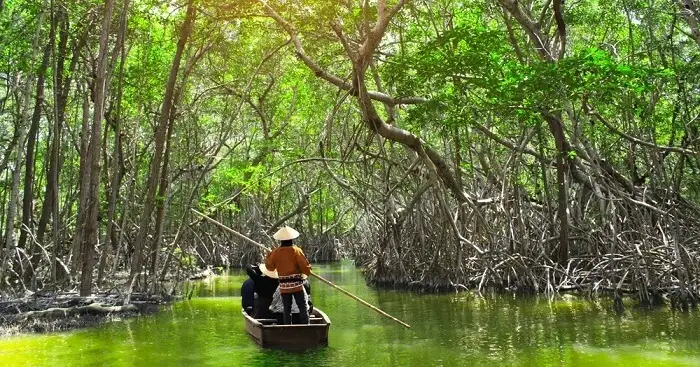
Baratang Island, in the North and Middle Andaman district of India, is best known among travelers for its narrow, emerald creeks and the iconic boat ride through dense mangrove forests en route to limestone caves. What is today a signature eco-experience grew out of a complex history of indigenous landscapes, colonial routes, post-independence connectivity, environmental change, and evolving tourism policy. This article traces that history and explains how the mangrove boat ride became a defining attraction of Baratang—and of Andaman ecotourism more broadly.
Baratang sits amid a web of tidal channels—Middle Strait, Homfray Strait, and other creeks—that weave between South and Middle Andaman. These brackish lanes are edged by robust mangrove belts, notably Rhizophora and Avicennia species, whose prop roots knit the shoreline against tides and cyclones. Inland, patches of limestone and calcarenite host small but striking karst formations and caves. The famous boat ride threads through these creeks to a landing point from which a short forest walk leads to the limestone caves.
Long before the Andamans entered leisure itineraries, mangrove creeks functioned as “water roads” for fishing, foraging, and inter-village movement. Boats were practical necessities—shallow-draft craft could navigate the shifting tides more easily than overland travel through dense forests. For local communities, mangroves were sources of fish, crabs, timber, tannins, and protection from storm surges.
The broader region is home to the Jarawa, one of the indigenous peoples of the Andaman Islands. Much of the adjacent mainland corridor forms the Jarawa Tribal Reserve, legally protected to guard indigenous lifeways and habitats. This protection has profoundly shaped how and when outsiders could pass through the area—and, later, how tourism would be managed. The mangrove channels leading to the caves lie outside the reserve, but access to Baratang historically intersected with routes across or alongside protected areas.
Under British rule, the Andamans were administered chiefly from Port Blair as a strategic outpost and penal settlement. Baratang remained peripheral to these priorities, with limited formal infrastructure. Waterborne transport dominated movement between islands; the creeks were vital connectors for supplies and occasional administrative patrols.
After independence, efforts to connect scattered settlements accelerated. The Andaman Trunk Road (ATR), pieced together in stages in the late 20th century, created a land-based north–south corridor linking Port Blair with Middle and North Andaman. This brought Baratang into practical reach of the capital via a sequence of road segments, a vehicle ferry across the Middle Strait, and then a short drive to the island’s main jetty.
Even as it opened access, the ATR also cut alongside the Jarawa Reserve, prompting decades of legal and ethical debates over transit rights, conservation, and the safety and dignity of indigenous communities. These debates later shaped tourist movement and the very framing of Baratang as an ecotourism destination.
Local boats first carried residents, workers, and supplies across the creeks. As visitors began arriving in greater numbers in the 1990s, a pattern of informal sightseeing emerged—first opportunistic, then increasingly organized—highlighting three key attractions:
As demand grew, the Andaman and Nicobar Administration (including Forest and Tourism departments) moved to regulate operations. Key features of the modern ride took shape:
The growth of Baratang’s popularity coincided with rising criticism of tourist convoys on the ATR, where some operators encouraged unethical encounters with Jarawa people. Investigative reports around 2012, followed by court interventions and administrative orders (notably in 2012–2013), tightened rules: strict no-stopping protocols in the reserve corridor, bans on photography and solicitation, and closer enforcement. These measures reframed Baratang visits as low-impact, no-contact journeys that respect indigenous rights.
The Indian Ocean tsunami of December 2004 altered coastlines, jetties, and mangrove edges across the archipelago. In Baratang, mangroves—acting as a biological breakwater—buffered some wave energy, underscoring their protective value. Recovery efforts improved jetties, standardized boats, and strengthened administrative capacity, setting the stage for a more deliberately managed tourism model in the late 2000s and 2010s.
Today’s mangrove boat ride is emblematic of Andaman ecotourism: small motorboats glide beneath interlaced canopies; tides and light change the mood from hour to hour; kingfishers, mudskippers, and crabs animate the margins. The landing point leads to a guided walk along boardwalks and forest trails to the caves. By design, the experience compresses geology, ecology, and conservation into a short, accessible outing.
Because road access to Baratang involves the ATR and a vehicle ferry, visitor flows are often clustered into morning crossings, with return legs later in the day. The administration calibrates boat departures to creek conditions and wildlife sensitivity, limiting wakes and crowding. Policies such as plastic bans and waste carry-back complement this approach.
Few experiences pack so much into so little time: tidal forest, birdlife, quiet channels, a forest walk, and karst formations. The ride offers a gentle introduction to mangrove ecology—how salt-tolerant trees stabilize coasts and feed complex food webs—without demanding technical trekking or long sea voyages.
Baratang’s mangrove ride stands as a case study in how sensitive landscapes can be opened to visitors with guardrails: limited group sizes, local stewardship, safety standards, and cultural respect. While not flawless, the model shows how livelihoods and conservation can align when rules are clear and communities are central.
Climate change, sea-level rise, and stronger cyclones will test the resilience of Baratang’s mangroves. Continued channel management, habitat restoration, and community-led tourism can help maintain the delicate balance that makes the boat ride special. As travelers increasingly seek meaningful, low-impact experiences, the Baratang model—rooted in history, ethics, and ecology—offers a durable path forward.
Baratang’s mangrove boat ride is more than a scenic detour—it is a living narrative of human movement, environmental stewardship, and the careful opening of a sensitive landscape to the world. Its history is a reminder that the best tourism experiences are those that learn from the past, respect the present, and safeguard the future.
What makes us different from other tour package companies
Our travel experts have core and intense knowledge about Andaman sector with over 10 years of experience that will help you choose the best possible itinerary as per your requirements.
Our travel experts are just one call away during your tour to help you with any kind of immediate assistance so that your tour is a more enjoyable and hassle-free tour.
eAndamanTourism ensures best rates to all our esteemed guests since we have our own hotels and fleet of vehicles and drivers and there is no third-party involvement. This ensures personalized service and best rates.


Kindly enter the details below for your Andaman Tour Package


