
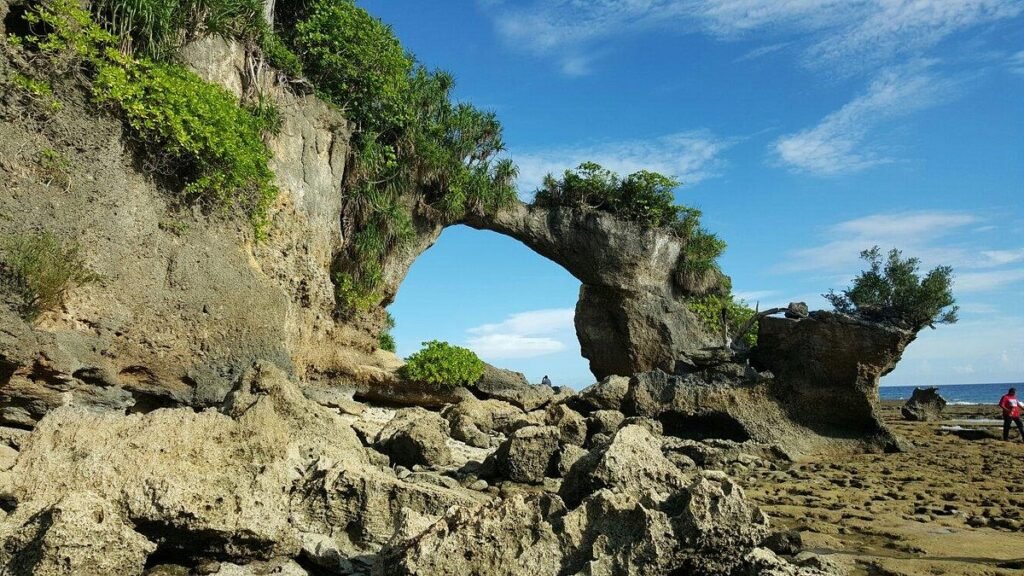
The Natural Rock Bridge of Neil Island—officially Shaheed Dweep—stands as one of the most photographed symbols of the Andaman and Nicobar Islands. Often nicknamed the “Howrah Bridge” by local settlers, this sea-carved limestone arch (in fact, two adjacent arches at very low tide) sits off Laxmanpur Beach No. 2 on the island’s western rim. It is a place where geology, community memory, and coastal tourism intersect in compelling ways.
Neil Island’s coast displays layers of coralline limestone—ancient reef material uplifted and then sculpted over millennia. The Natural Rock Bridge formed as waves and tides selectively eroded weaker portions of the limestone cliff, leaving behind a hardier “span.”
The result is a rugged arch festooned with small plants and, at its base, intertidal pools teeming with hermit crabs, sea cucumbers, grazing fish, and soft corals. A second, smaller arch lies further along the same reef platform and is best seen around low tide.
The Andaman archipelago has long been home to Indigenous Andamanese communities. While Ritchie’s Archipelago (which includes Neil Island) appeared on colonial-era charts, the Natural Rock Bridge itself does not feature prominently in historic survey narratives; it was, for generations, a local landmark within a broader seascape of reefs and mangroves.
After India’s independence, the Andamans saw waves of settlement and agricultural development. A substantial number of Bengali-speaking families made their homes on Havelock (Swaraj Dweep) and Neil (now Shaheed Dweep). Locals began affectionately calling the arch “Howrah Bridge,” drawing a playful parallel with Kolkata’s iconic span. The nickname stuck, and guides still use it today.
In late 2018, the Government of India announced new names for several islands to honor the freedom struggle. Neil Island officially became Shaheed Dweep. In tourism and everyday speech, both “Neil Island” and “Shaheed Dweep” are widely used, often interchangeably.
While locals had long known the arch, its fame grew in the 1990s and 2000s as domestic tourism to the Andamans expanded. Travelers sought quieter alternatives to busier beaches and dive sites, and the Natural Rock Bridge—especially dramatic at low tide—fit the bill. The emergence of social media multiplied its visibility, making sunset shots through the arch a near-ritual.
As visitor numbers rose, small-scale entrepreneurship followed: local guides began escorting guests across the reef platform, vendors offered refreshments near the entry path, and signboards advised visitors about tides and safety. The site became both a shared community asset and a livelihood anchor.
Major oceanic events, including the 2004 Indian Ocean tsunami, reshaped shorelines across the Andaman region. On Shaheed Dweep, altered water levels and reef exposure patterns affected how and when people approach the arch. Despite these changes, the Natural Rock Bridge endured—its ongoing survival a reminder of nature’s capacity for both fragility and resilience.
Community members, guides, and local authorities encourage responsible visitation: sticking to established pathways at low tide, avoiding the arch’s span, and keeping the intertidal zone free of litter. Many guides act as informal interpreters of the reef, pointing out organisms and explaining seasonal changes.
The “Howrah Bridge” moniker evokes migration and memory—settlers linking a new coastal home to a storied bridge in Bengal. The official name Shaheed Dweep places the island in a national narrative of sacrifice and freedom. Together, these names reflect the arch’s dual identity as both a local landmark and a symbol within a larger Indian story.
Local visitation is longstanding, but broader tourism surged from the 1990s onward with improved ferry links, growing domestic travel, and later, social media visibility.
It is entirely natural. Its shape results from wave erosion and weathering of coralline limestone.
Settlers of Bengali origin informally dubbed it “Howrah Bridge,” likening the natural span to the famed bridge in Kolkata. The nickname spread via guides and visitors.
The Natural Rock Bridge thrives as a destination precisely because it feels wild. Protecting that quality requires balancing access with limits: clear signage, tide-aware visiting, guide-led interpretation, and zero tolerance for litter and reef trampling. As climate pressures grow, community stewardship and visitor restraint will determine how future generations experience this remarkable arch.
The Natural Rock Bridge is not just a pretty backdrop. It is a living intersection of geology, migration, memory, and modern tourism—an Andaman story carved in stone and told by the sea.
What makes us different from other tour package companies
Our travel experts have core and intense knowledge about Andaman sector with over 10 years of experience that will help you choose the best possible itinerary as per your requirements.
Our travel experts are just one call away during your tour to help you with any kind of immediate assistance so that your tour is a more enjoyable and hassle-free tour.
eAndamanTourism ensures best rates to all our esteemed guests since we have our own hotels and fleet of vehicles and drivers and there is no third-party involvement. This ensures personalized service and best rates.


Kindly enter the details below for your Andaman Tour Package


